This blog owes a debt to Joanna Jeffery, whose excellent weekly Circles newsletter and long-running tracker, The List, have become essential reading for anyone trying to keep up with how grantmaking in the UK is actually changing in real time. Jo’s email on 3rd August 2026 sent us back through a stack of 2025/26 sector research. The analysis, and any argument we’re picking with the data, is ours.
The double bind facing faith and heritage charities
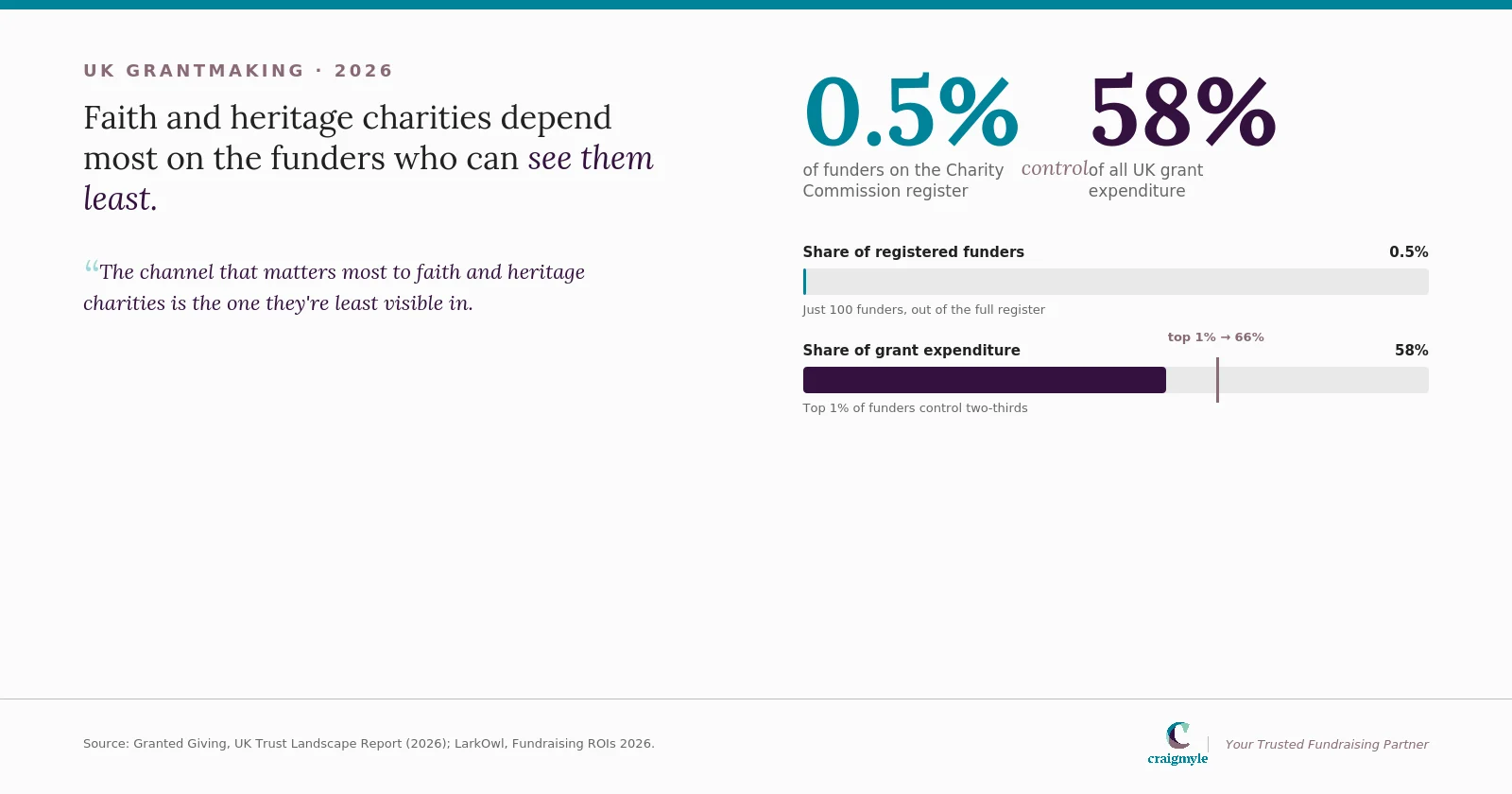
Let’s start with an uncomfortable number. Just 100 funders (0.5% of everyone on the UK trust and foundation Charity Commission register) now control 58% of all grant expenditure, according to Granted Giving’s UK Trust Landscape Report. The top 1% control two-thirds. If you run a faith group or a heritage charity, in fact any charity, your fundraising strategy increasingly depends on getting noticed by a shrinking handful of very large, very selective gatekeepers.
Now add a second problem. Faith organisations barely register as a category in the major surveys and landscape reports the sector uses to understand itself. For example, in NPC’s State of the Sector and the Third Sector Trends study, religion as a cause area is largely absent. Heritage fares differently but no better. It’s one of the most competitive fields in the funding landscape. Granted Giving’s data puts roughly eleven charities chasing every funder that lists arts, culture or heritage as an interest, against fewer than three for something like armed forces causes.
Put those together and you get a genuine strategic problem, not an academic one. Funders design programmes based on this evidence base. Peer benchmarking, the kind that tells a trustee board whether their reserves policy is normal or their cost-of-fundraising ratio is acceptable, barely exists in the same form for a parish restoration appeal or a synagogue’s welfare fund. You can’t benchmark against data that was never collected about you.
The UK Grantmaking ground is shifting
As government funding has receded, from around 37% of sector income in 2009/10 to roughly 26% today in 2026 , trusts and foundations have become relatively more important, recently overtaking overtaken government as the largest single source of grant income to the sector. UK Grantmaking 2026 recorded more than 14,000 grantmakers distributing £24bn last year. That should be good news for faith and heritage groups focusing on trust fundraising. Except the return on that effort is falling. LarkOwl’s Fundraising ROIs 2026 study puts trust fundraising ROI at £8.38 for every pound spent, down from £10.69 in 2021. And research from Nottingham Business School’s VCSE Barometer found over half of charities are already drawing down reserves just to cover ordinary running costs. For faith and heritage organisations, often the very reserves earmarked for buildings, restoration or legacy, not operations.
That’s the double bind. The channel that matters most to you is the one you’re least visible in, and it’s delivering a worse return than it used to, at exactly the moment you may be leaning on it hardest. It’s worth noting that the pace of funder closures and pauses Jo’s List has spent two years cataloguing is itself part of the concentration story above with fewer funders, chasing fewer applications, from a shrinking pool of large donors.
So what’s the debate?
For funders and sector bodies, if a fifth of registered charities’ activity sits in a cause area your own research doesn’t reliably capture, how confident should anyone be in the picture ‘the sector’ paints?
For faith and heritage organisations, are you contributing to the surveys and datasets that shape funder priorities, or opting out and then wondering why the landscape doesn’t seem built for you?
And for the wider fundraising community, is falling ROI a temporary correction, or the first sign that trust fundraising can’t actually absorb the volume the state has walked away from?
We don’t think there are satisfactory answers to any of these questions yet. We’d genuinely like to hear what you think.
Get involved
We’re noting, observing and considering all of this ourselves — developing something considered, let alone wisdom, on a shift this significant isn’t easy, and won’t come from one organisation alone. If any of this resonates or unsettles you please get in touch. Craigmyle works with faith, heritage and community charities on trust fundraising strategy, funder research and building income beyond an increasingly concentrated pool of grantmakers. Get in touch if you’d like to talk it through on first@craigmyle.org.uk or call 01582 762441.